
AI Landing Page Revamp: Modernize Your Page for 2x Conversions
Is your current marketing page failing to convert paid ad traffic? Discover how automated AI landing page revamps transform outdated visual layouts into high-converting conversion engines in minutes.
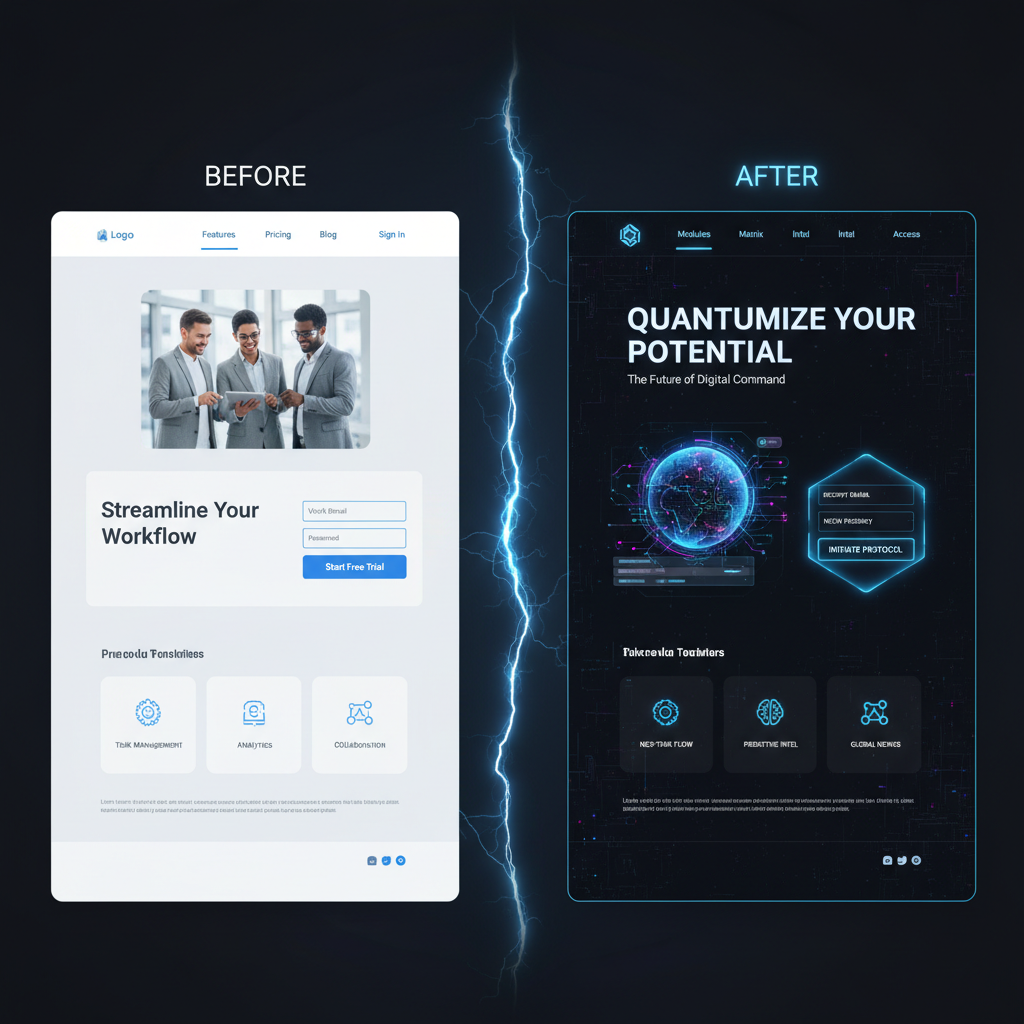
Why Landing Pages Suffer Conversion Decay Over Time
Digital marketing standards and user expectations evolve rapidly. A landing page layout that converted exceptionally well two years ago may now suffer from visual fatigue, slow mobile loading speeds, or outdated design aesthetics that cause modern visitors to hesitate and bounce.
When visitors land on your page from Google Ads, Meta campaigns, or organic search, they judge your product credibility within 3 seconds. Outdated typography, cramped container margins, low-contrast call-to-action buttons, or broken mobile breakpoints create immediate friction.
An AI landing page revamp allows growth teams to retain their proven value propositions and core messaging while completely modernizing the visual interface, CSS grid structures, and interactive call-to-action modules automatically in minutes.
The 4-Step AI Landing Page Revamp Workflow
Modernizing an existing landing page no longer requires coordinating between copywriters, Figma designers, and front-end developers over a month-long sprint. Here is how generative AI streamlines the entire revamp lifecycle:
Ingest Live Landing Page URL & DOM Parsing
Paste your existing marketing page URL into Redesignr.ai. The AI DOM engine analyzes your current copy hierarchy, layout containers, heading structures, and image assets without disrupting backend analytics tracking tags or pixel scripts.
Apply Conversion-Optimized Aesthetic Patterns
Select modern visual presets like Bento Grid layouts, Linear-inspired dark themes, or Glassmorphic card containers to restructure your hero section, feature blocks, social proof badges, and pricing tables automatically.
Visual & Prompt Engineering Refinement
Use natural language prompt inputs alongside an interactive WYSIWYG visual editor to tweak typography scaling, adjust CTA button contrast, modify spacing tokens, and fine-tune mobile responsive breakpoints.
Export Standalone Clean React & HTML Code
Download complete, production-ready HTML5, CSS3, and React component code. Host your revamped landing page on Vercel, Netlify, Cloudflare Pages, or your custom server with zero vendor lock-in.
Essential Elements of a High-Converting AI Revamp
1. Hero Section Conversion Framing
The hero section is responsible for 80% of visitor retention. An AI revamp restructures your hero block into a clear 3-part layout: an 8-word primary outcome headline, a supporting sub-headline addressing key customer objections, and a high-contrast primary CTA button paired with trust badges.
2. Bento Grid Modular Feature Showcase
Instead of overwhelming visitors with long paragraphs of dense text, AI revamps organize product capabilities into visual 12-column Bento Grids. Each Bento card combines a short benefit title, illustrative graphic, and concise description.
3. Mobile-First Fluid Grid Architecture
With over 60% of web traffic arriving on mobile devices, an AI revamp ensures fluid container queries and responsive flexbox breakpoints, guaranteeing seamless rendering on smartphones, tablets, and 4K displays.
Revamping a page that already receives traffic is a different exercise from designing one, because you have evidence and you can destroy it. The most expensive mistake is replacing a page that was working better than the thing that replaced it, and never finding out.
Find out what is actually wrong first
"It needs a revamp" is usually a feeling. Your analytics can turn it into a diagnosis, and the diagnosis changes what you should do.
If people arrive and leave within seconds, the problem is at the top: they cannot tell they are in the right place, and the fix is the headline and opening section rather than the page.
If they read most of the way down and do not act, the problem is the argument — an objection unanswered or an unconvincing call to action. If they start the form and abandon it, the problem is the form.
These need different work, and revamping the whole page addresses all three by accident while teaching you nothing.
Build a challenger, not a replacement
If the page has meaningful traffic, the safe move is to treat the new version as a challenger and run it against the current one rather than switching.
This used to be impractical for pages below a certain volume, because producing the challenger cost more than the page was worth. Generating it from the live URL makes it cheap enough to be worth doing for far more pages.
Where traffic is genuinely too low for a test to conclude, switch — but switch with a baseline recorded and a date to review it, so "we revamped it and things got worse" is a thing you can discover rather than suspect.
Change enough to learn something
The opposite failure to reckless replacement, and just as common.
A challenger that moves a button and adjusts a shade produces a result you cannot interpret and cannot act on. If you are going to spend the traffic, the variant should differ in a way that would tell you something: a different opening argument, a different section order, a materially different form length.
Generating from the existing page helps here, because the content is held constant while the structure and emphasis change. That is a cleaner comparison than a variant where copy and layout both moved.
Carry forward the things you have already paid to learn
A page that has been running has accumulated knowledge, and revamps routinely discard it.
If a testimonial was added because it lifted conversion, if a headline won a previous test, if an FAQ entry was added because sales kept answering that question — those are findings, and they should survive into the new version deliberately rather than by luck.
Write them down before you start. It takes ten minutes and it prevents the most annoying category of revamp failure, which is relearning something you already knew.
Keep the plumbing intact
A revamped page is a new page as far as your tooling is concerned, and the tooling is easy to forget.
Tracking scripts and conversion pixels have to be re-added — they are not part of a generated page. UTM handling has to survive to the form submission. If the URL changes, every ad, email and sales sequence pointing at the old one needs updating or redirecting.
Ads are the ones that catch people out. A campaign pointing at a URL that now 404s spends money on nothing, and it can run for days before anyone notices.
- Analytics and pixels — re-add them; generated pages have none.
- Form destination — test the full path to the CRM record.
- UTM pass-through — attribution has to reach the submitted record.
- Ad and email destinations — update them or redirect, before launch not after.
Give it long enough to mean something
Conversion rate is noisy at the volumes most landing pages see, and the first days after a change are the noisiest.
Decide in advance how long you will run it and what result would make you keep the new version. Calling a test after two days because the number moved is how teams convince themselves of things that are not true.
And record the outcome somewhere durable. The value of testing compounds only if the findings survive the person who ran the test.
Diagnose before revamping, run the new version as a challenger where traffic allows, carry forward what previous tests taught you, and re-add the tracking — generated pages arrive with none.
Frequently Asked Questions
How often should a SaaS landing page undergo a visual revamp?
High-growth SaaS companies typically revamp landing page designs every 6 to 12 months. Periodic revamps align your visual presentation with updated brand positioning, allow you to test new feature messaging, and maintain modern design standards that prevent visitor bounce rates.
Will revamping my landing page with AI break analytics and tracking scripts?
No. Redesignr.ai exports standalone, clean HTML and React code that allows you to easily re-attach Google Analytics, Meta Pixels, PostHog, Mixpanel, and custom conversion tracking scripts without conflicts.
How does a landing page revamp improve Google Quality Scores and lowering PPC costs?
A modern AI landing page revamp improves page loading speeds under 1.5 seconds, optimizes mobile responsiveness, and clarifies headline-keyword relevance. Google Ads rewards faster, higher-converting landing pages with improved Quality Scores, directly lowering your Cost Per Click (CPC) and Cost Per Lead (CPL).
Can I revamp my landing page without touching backend server logic?
Yes. Visual AI redesign platforms operate strictly on the frontend UI presentation layer. Your existing backend APIs, form handlers, database endpoints, and payment gateways remain completely unchanged.
Revamp Your Landing Page with AI Today
Enter your current landing page URL into Redesignr.ai to generate a modern, high-converting visual redesign complete with clean React code in seconds.
Start Landing Page Revamp