
Agency Website Redesign: Showcase Portfolios & Win Clients
Elevate your creative agency's web presence with modern dark-mode aesthetic themes, interactive Bento portfolios, and fast client pitch prototyping.
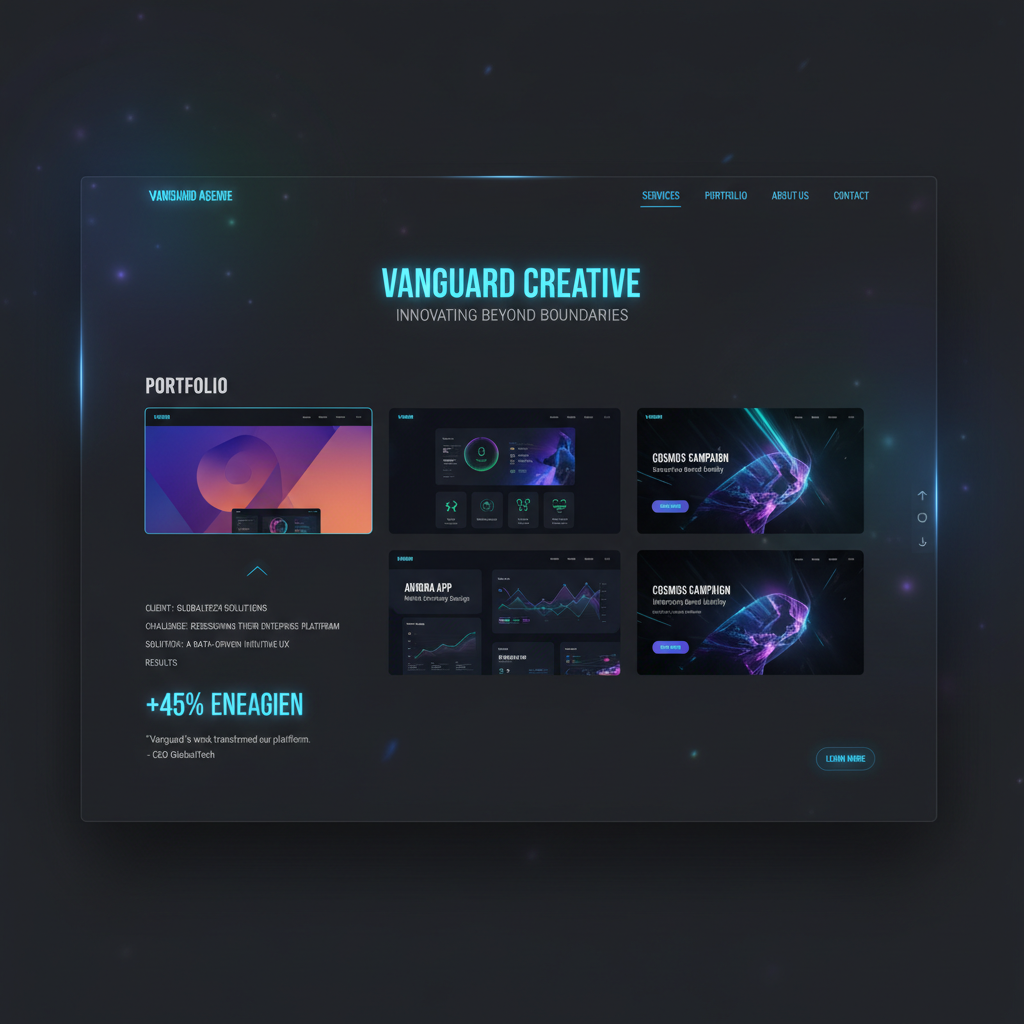
Why Your Agency Website is Your Most Critical Sales Asset
For creative agencies, digital marketing firms, and web development studios, your website is the primary proof of your team's design taste, technical capability, and user experience expertise. Prospective clients judge your agency's execution standards based on the quality of your own homepage.
When prospective enterprise clients evaluate high-ticket retainers, an outdated agency website with generic stock photos, slow mobile page loads, or broken layout grids creates immediate trust issues.
Incorporating generative AI visual workflows allows agency teams to maintain a state-of-the-art web presence while drastically reducing internally spent billable hours.
By streamlining client discovery pitches with instant AI visual mockups, creative directors can close retainer deals before competitors even submit initial design proposals.
Redesignr.ai helps agencies redesign their own web portals and generate instant client pitch concepts by ingesting live URLs and outputting clean, modern React code components.
4 Key Focus Areas for Agency Website Redesign
1. Premium Bento Grid Portfolio Case Studies
Digital marketing and design agencies must demonstrate cutting-edge visual craft. Redesignr structures agency portfolio projects into interactive Bento Grid containers complete with dark mode glassmorphism and video embeds.
2. Transparent Service Package & Pricing Tables
Present agency retainers, project scopes, deliverable timelines, and client ROI guarantees in clear, scannable comparison tables that reduce sales friction.
3. Executive Client Social Proof & Testimonials
Highlight verified client reviews, star ratings, case study metrics (e.g. +240% conversion lift), and corporate logos above the fold to build immediate authority.
4. Rapid Client Pitch Prototype Generation
Use Redesignr.ai to ingest a prospective client's live URL during pre-sales discovery, generating a modernized visual redesign concept in 30 seconds to win client pitches.
For an agency, generation changes the economics of client work at two specific points — the pitch and the first draft — and changes almost nothing in the middle. Knowing where the gain actually is prevents the two mistakes agencies make when adopting these tools.
The pitch is where the leverage is
Arriving at a new business conversation with three redesigns of the prospect's own homepage is a materially different proposition from arriving with a portfolio of other clients.
It moves the conversation from whether you are capable to which direction they prefer — and the second conversation is much easier to win. It also demonstrates that you have engaged with their actual site rather than sent a generic deck.
The cost is minutes. Very few agencies do this, which is exactly why it works at the moment.
First drafts, and what they do to the brief
Getting from a client's existing site to something concrete enough to react to is disproportionately slow, because clients cannot brief in the abstract. They respond to pages, not to questions about their preferences.
Generating directions before the kickoff inverts this. Instead of extracting a brief through conversation and then producing something, you produce something and let their reaction be the brief.
The reaction is more accurate than the brief would have been. Clients who cannot articulate what they want are usually perfectly clear about what they do not want once they see it.
The middle is unchanged
Between the approved direction and the launched site, generation helps less than people expect.
Integrations, content migration, stakeholder management, accessibility compliance, redirect mapping, launch coordination — none of these are production problems, and they are where agency projects actually overrun.
So the honest internal expectation is a compressed early phase and an unchanged delivery phase. Agencies that plan for a proportionally faster project are disappointed; ones that plan for a faster start are not.
Two mistakes to avoid
The first is repricing on production cost. Clients buy an outcome and accountability, not your hours, and passing production efficiency through as a discount trains a market that will not sustain the rest of the work. The value of the strategy and the accountability did not fall.
The second is skipping the direction conversation because generating is easy. Three generated options presented without a point of view is worse than one recommendation with reasoning. Clients hire an agency for the judgement about which direction is right — offering a menu returns that decision to them and undersells what they are paying for.
Where it fits in a delivery workflow
The pattern that seems to work: generate directions before the kickoff, use the client's reaction to write the brief, then take the chosen direction into your own process and apply your house standards.
Treat the output as a starting position rather than a deliverable. What ships should carry your judgement — the generated draft is what removes the blank page, not what replaces the work.
And deliver standard code the client owns. Clients who cannot leave you eventually resent you, and clients who own their site refer more often.
- Generate before the kickoff — let their reaction be the brief.
- Present a recommendation — not a menu. The judgement is what they are buying.
- Price the outcome — production cost is not the value you provide.
- Hand over ownership — standard code, credentials in the client's name.
Your own site, which is always last
Every agency has the same problem: their own site is two or three years behind their current work, because internal time loses every contest with billable time.
This is the one place where the production saving translates directly, since there is no client, no approval cycle and no integration work — the only obstacle was ever the hours.
Refresh the homepage and the two strongest case studies. That is an afternoon, and it is the site prospects use to judge whether to call you.
The gain is at the pitch and the first draft, not in delivery. Generate directions from the prospect's own site before the kickoff, present a recommendation rather than a menu, and do not reprice on production cost.
Frequently Asked Questions
How can digital agencies use AI to win more client redesign contracts?
Digital agencies use Redesignr.ai during pre-sales pitches to ingest a client's current outdated URL and generate a live, modern React prototype in under 30 seconds, demonstrating immediate value.
Does Redesignr export clean React code that agencies can customize?
Yes. Redesignr exports 100% standalone HTML5, CSS3, and React component code with zero platform lock-in, allowing agency developers to tailor code to client requirements.
Can agencies white-label or host generated web pages on client servers?
Yes. Because exported code is standalone, agencies can deploy generated React code to Vercel, AWS, Netlify, or client CMS environments without paying recurring builder subscriptions.
Redesign Your Agency Website Today
Enter your agency website URL into Redesignr.ai to generate a high-converting, modern agency layout in seconds.
Redesign Agency Site Now